
Understanding Unique Traits of Candida Albicans
Fungi possess a fascinating array of characteristics that set them apart from other living organisms. Candida albicans, a common yeast, is particularly intriguing due to its adaptability and resilience. This opportunistic pathogen has evolved unique survival strategies that allow it to thrive in diverse environments, evade immune responses, and cause infections in susceptible individuals.
Candida albicans is more than just a common yeast — it’s a shape-shifting, biofilm-forming fungal organism that can quietly overgrow in the gut, skin, and mucosal tissues. Understanding its unique fungal characteristics is key to knowing how it thrives, evades the immune system, and contributes to chronic health issues.
In this article, I’ll break down its growth forms, how it switches from harmless yeast to invasive hyphae, and why its adaptability makes it one of the most studied fungal pathogens in human health.
If you’ve explored other pages on this website, you may have realised that fungi have well-defined yet unusual traits. A good article to read is what are fungi?
Not all fungi are necessarily beneficial for our health. While some fungi contribute positively to ecosystems and even human health, others, like Candida albicans, can pose significant challenges when they overgrow in the body
Candida Exists in Three Forms

Candida albicans is a “polymorphic” fungus, meaning it can switch between multiple forms depending on environmental conditions. This ability makes it a formidable pathogen that is often difficult to eliminate. The three primary forms of Candida include:
Candida albicans can exist in 3 different biological living phases:
The three living forms are yeast, pseudo-hyphae and hyphae. They all differ in their cell size, shape, and structure, as well as their function and growth conditions.
The Role of Shape-Switching in Candida’s Survival
Candida’s ability to switch between these forms is a key factor in its disease-causing ability (pathogenicity). It has also learned how to survive using 5 different survival strategy characteristics it has acquired over a long time.
The transition from the yeast form to hyphae enhances its ability to invade host tissues and evade immune-activity from white-blood cells (neutrophils and macrophages). Studies have shown that the hyphal-form plays a critical role in tissue invasion and systemic infections. (Mayer et al., 2013), (Chen et al., 2020).
A recent study found Candida albicans’ ability to shift forms can help it cause dangerous infections, and a study suggests that a protein called Sir2 aids this transition (Hsu et al., 2021).

1 – Yeast Cell – budding form
The yeast form of Candida albicans consists of single, oval-shaped cells that reproduce asexually through a process called budding. In this form, Candida remains relatively benign and often coexists peacefully with other microorganisms in the gut, mouth, and vaginal microbiota.
Key Features of Yeast Cells:
2 – Pseudohyphae – transitional form
Pseudohyphae represent an intermediate stage between yeast and true hyphae. This form arises when yeast cells fail to fully separate after budding, resulting in elongated chains of cells connected at constriction points.
Key Features of Pseudohyphae:
udohyphae, hyphae have parallel walls and can deeply invade host tissues, leading to systemic infections.
3 – Hyphae – invasive form
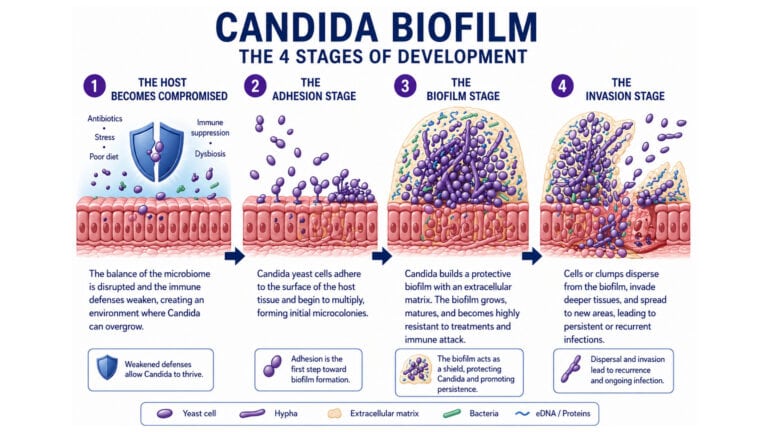
Hyphae contribute to the development of Candida biofilms, which are structured microbial communities that adhere to surfaces such as mucosal linings, catheters, and medical implants. These biofilms make infections much harder to treat.
Key Features of Hyphae:
- Essential for tissue invasion and biofilm formation.
- Can evade immune defenses by altering their surface proteins.
- Can form mycelium, a dense network of hyphal structures.
- More resistant to antifungal treatments compared to the yeast form.
Candida Is Polymorphic
For years, scientists believed that Candida albicans was “dimorphic”, meaning it could only switch between yeast and hyphae. However, modern research has revealed that Candida is polymorphic, meaning it can adopt multiple different shapes depending on environmental conditions.
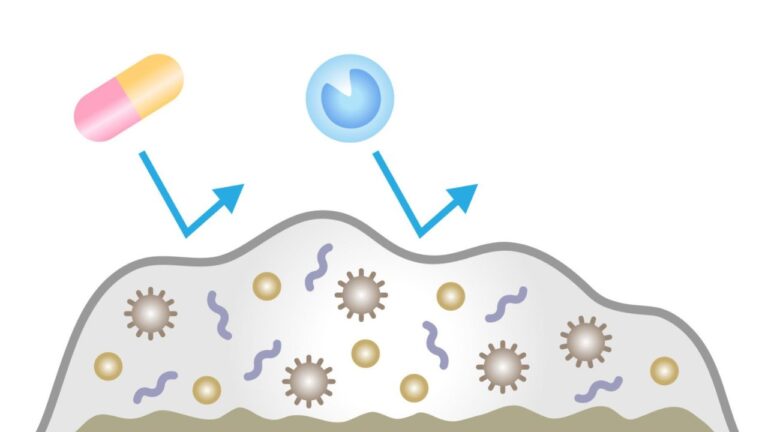
Candida’s ability to switch forms and build biofilms makes it significantly more resistant to antifungal treatments compared to bacteria’s susceptibility to antibiotics. This is why recurrent Candida infections are common, and treatment often requires a comprehensive approach, including dietary changes, probiotics, and targeted antifungal therapy.
The Concept of Polymorphism
Bacteria is Monomorphic
Many of our virulent bacterial pathogens are genetically monomorphic, meaning, they do not change shape. (Achtman 2008) This makes them an easier target for drugs like antibiotics, and explains the wide success of antibiotics, and the difficulties in treating yeast infections with antifungal drugs.
Candida vs. Bacteria: The Challenge of Treatment
Unlike bacteria, which are typically monomorphic (maintaining a fixed shape), Candida’s polymorphic nature makes it a “continually moving target” for treatment. Most bacterial infections respond well to antibiotics, but fungal infections, particularly those caused by Candida, are much more difficult to eradicate.
Key Differences Between Bacteria and Candida:
| Feature | Bacteria | Candida Albicans |
|---|---|---|
| Cell Type | Prokaryotic | Eukaryotic |
| Morphology | Monomorphic | Polymorphic |
| Reproduction | Binary fission | Budding, hyphal formation |
| Immune Evasion | Limited strategies, biofilms | Shape-shifting, biofilms, immune suppression |
| Drug Susceptibility | Antibiotics (increasing resistance) | Antifungal drugs (often less effective) |
Conclusion
Candida albicans is a fascinating yet challenging pathogen due to its ability to morph into different forms, evade immune defenses, and resist treatment. Understanding its unique fungal characteristics is crucial for developing effective treatment strategies.
Because Candida is polymorphic, it can thrive in various environments and adapt to changes in the host. This adaptability explains why some individuals struggle with recurrent Candida infections and why a multifaceted approach is necessary for long-term management.
By comprehensively addressing diet, gut health, and antifungal strategies, it is possible to keep Candida in check and maintain a balanced microbiome. Understanding the nature of Candida is the first step toward effective prevention and treatment.

Eric Bakker N.D.
Greetings! I am a naturopathic physician from New Zealand. Although I’ve retired from clinical practice since 2019 after 34 years of clinic. I remain passionate about helping people improve their lives. You’ll find I’m active online with a focus on natural health and wellbeing education through my Facebook page, Reddit page and YouTube channel, including this website.